Decentralizing the Skies
Research carried out alongside the M.S. in Software Design and Architecture at Munster Technological University — on Edge AI and decentralized decision-making for Unmanned Aircraft System Traffic Management (UTM).
Unmanned Aircraft System Traffic Management (UTM) Decentralization
Unmanned Aerial Vehicle (UAV) Edge AI Potentials for Unmanned Aircraft System Traffic Management (UTM)
Mohamed Omar Mohamed, Olivia Brickley — Dept. of Computer Science, Munster Technological University, Cork, Ireland
The success of most UAV-based IoT applications is heavily dependent on artificial intelligence (AI) technologies, for instance, computer vision and path planning. These AI methods must process data and provide decisions while ensuring low latency and low energy consumption. However, the existing cloud-based AI paradigm finds it difficult to meet these strict UAV requirements. Edge AI, which runs AI on-device or on edge servers close to users, can be suitable for improving UAV-based IoT services. This paper provides a comprehensive analysis of the impact of Edge AI on key UTM cloud-based systems, considering communication time and bandwidth challenges — examining how compressed ML modules deployed to a UAV's onboard flight controller could take on some decision-making, moving toward a more decentralized UTM architecture.
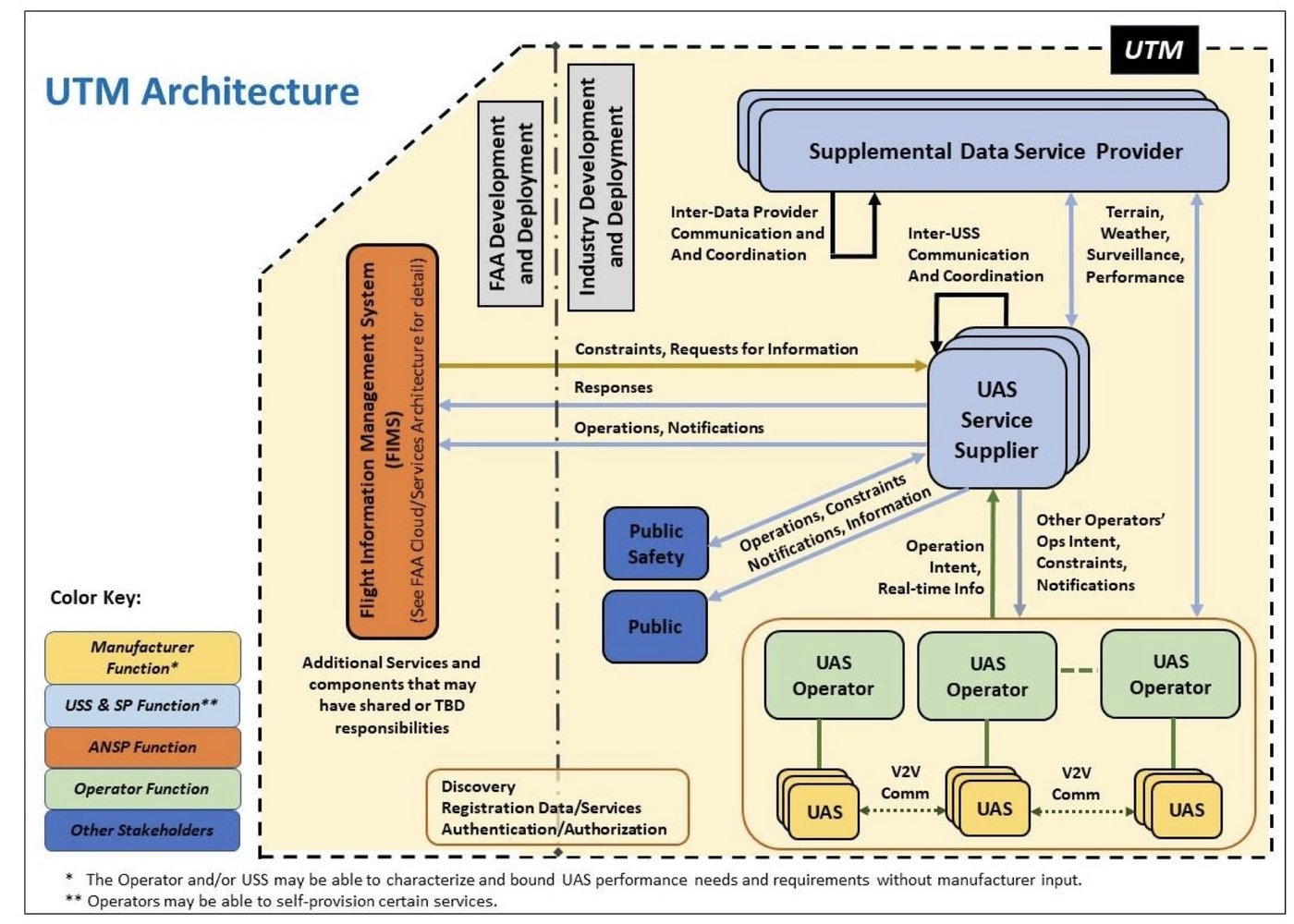
UTM integration architecture, from the conference paper above.
Service Management System for Unmanned Aircraft System Traffic Management (UTM)
Mohamed Omar Mohamed — Faculty of Engineering and Science, Dept. of Computer Science, Munster Technological University
The Unmanned Aircraft Systems (UAS) market is growing rapidly, with an estimated 250,000 new air vehicles predicted to be in operation by 2035 — driving the need for proper infrastructure and regulation to facilitate urban air mobility. For UAS service providers, coordinating flight planning across insurance, flight certificate systems, aircraft registration systems, regional and multi-regional UTM systems, vertihubs, vertiports, and maintenance/repair/overhaul (MRO) is a tremendous challenge and a new layer of complexity in a fully automated process. This proposal presents an innovative design for an unmanned aircraft service management system, discussing the architecture, integration, event handling, and design challenges of a service management system (SMS) for UAS — helping coordinate UAS flights and ground support automation and reservation.
Alongside the written proposal, the research included hands-on experimentation: building an actual test drone and wiring its flight controller to a microcontroller to monitor flight telemetry in real time, with flight data streamed up to the cloud — a small-scale proof of concept for the decentralized, edge-aware decision-making explored in the UTM work above.
Aligning Design Thinking with Systems Thinking
Mohamed Omar Mohamed — developed during the CPD Diploma in Business Innovation and Digital Transformation, TU Dublin
Exploring how Design Thinking and Systems Thinking can work together rather than in isolation — using Lean Agile methods as the bridge to apply Design Thinking practices within an Agile delivery framework, so that user-centered discovery and iterative, systems-level problem solving reinforce each other instead of pulling in different directions.